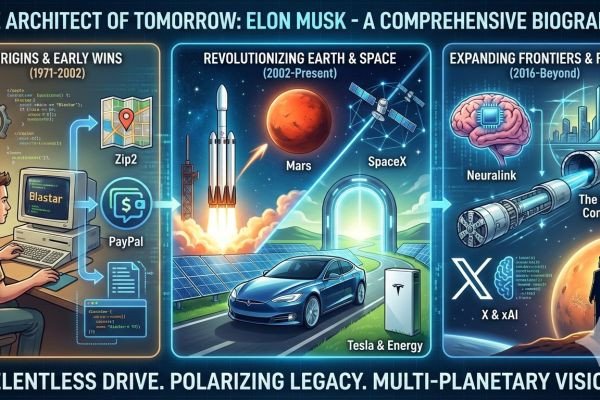
Origins: From Pretoria to Silicon Valley
Born on June 28, 1971, in Pretoria, South Africa, Musk developed an early appetite for computing and science fiction. Influenced by works like Isaac Asimov’s Foundation series and Douglas Adams’s The Hitchhiker's Guide to the Galaxy, he became fascinated by the long-term survival of humanity. At just 12 years old, he taught himself programming from a user manual and sold the code for a space-themed video game called Blastar to a computer magazine for $500.
Seeking greater economic opportunities and wishing to avoid South Africa's mandatory military service under the apartheid regime, Musk immigrated to Canada in 1989 at age 17, utilizing his mother's Canadian citizenship. After working odd jobs at a farm and a lumber mill, he enrolled at Queen's University in Ontario. He later transferred to the University of Pennsylvania, where he earned dual bachelor’s degrees in physics and economics in 1997. In 1995, he moved to California with the intention of pursuing a Ph.D. in energy physics at Stanford University. However, the booming internet age beckoned. He dropped out after just two days to ride the wave of the dot-com boom, laying the foundation for his future empire.
The First Milestones: Zip2 and PayPal
Musk’s first major venture was Zip2, an online business directory and city guide he co-founded with his brother, Kimbal. The early days were a masterclass in bootstrapping; Musk reportedly coded the website at night while it ran during the day, sleeping in the office and showering at a local YMCA to keep costs down. His relentless work ethic paid off. In 1999, Compaq acquired Zip2 for over $300 million in cash, netting Musk $22 million for his 7% share.
Rather than resting on his laurels, Musk immediately poured his capital into X.com, one of the first federally insured online banks. The company soon merged with its rival, Confinity, to form the digital payment juggernaut PayPal. Although Musk was eventually ousted as CEO due to internal technical disagreements, his stakeholder position yielded a massive payday when eBay acquired PayPal for $1.5 billion in 2002. Musk walked away with roughly $165 million, providing the seed capital necessary to pursue his childhood dreams of space exploration and clean energy.
Making Humanity Multi-Planetary: SpaceX
In 2002, frustrated by the global stagnation in space exploration, Musk founded Space Exploration Technologies Corp. (SpaceX). His audacious goal was to drastically reduce the cost of space travel and eventually colonize Mars to make humanity a multi-planetary species. The early days were plagued by near-ruinous failures; the first three launches of the Falcon 1 rocket exploded, bringing the company to the brink of bankruptcy. However, the fourth launch in 2008 succeeded, securing a lifeline contract from NASA.
Over the next two decades, SpaceX achieved historic milestones, including the development of reusable rockets (the Falcon 9 and Falcon Heavy) and the creation of Starlink, a massive satellite internet constellation that currently boasts thousands of active satellites. By 2026, SpaceX had cemented its dominance in the aerospace industry, marked by the ongoing development of the Super Heavy-Starship system and a massive corporate consolidation that merged Musk's artificial intelligence startup, xAI, into SpaceX.
Driving the Future: Tesla
While building rockets, Musk also set his sights on revolutionizing the automotive industry. In 2004, he became the largest early investor in Tesla Motors (now Tesla, Inc.), an electric car company founded by Martin Eberhard and Marc Tarpenning. Musk eventually took over as CEO and product architect in 2008. Tesla faced its own brush with death during the 2008 financial crisis and again during the harrowing Model 3 production ramp-up in 2018. Through it all, Musk enforced a grueling work culture, famously sleeping on the factory floor to oversee production lines.
The perseverance transformed the public perception of electric vehicles from slow, impractical novelties into highly desirable, high-performance machines. Today, Tesla is a global leader in EV sales and renewable energy solutions, having absorbed SolarCity to offer integrated battery and solar products. Musk’s profound impact on the company's valuation was underscored in late 2025 when shareholders approved a historic $1 trillion pay package tied to long-term performance milestones.
Expanding the Frontier: Neurotech, Tunnels, and AI
Musk’s capacity for parallel innovation led to the creation of several other ambitious ventures:
Neuralink (2016): A neurotechnology company developing implantable brain-machine interfaces designed to treat neurological conditions and eventually bridge the gap between human cognition and artificial intelligence.
The Boring Company (2017): An infrastructure firm aiming to tackle urban traffic congestion through advanced underground tunneling, with its first major operational loop under the Las Vegas Convention Center.
X Corp. and xAI: In 2022, Musk acquired the social media platform Twitter for $44 billion, taking it private and controversially rebranding it as "X." Leveraging the massive data engine of X, he launched xAI to compete in the generative AI race, developing the Grok chatbot. By early 2026, xAI had secured billions in international backing before officially being consolidated into the SpaceX umbrella.
A Complex and Transformative Legacy
As Musk's wealth and influence have grown, so too has his political and social footprint. The once progressive-leaning climate advocate has transformed into a highly polarizing and outspoken figure. He has frequently engaged in public disputes, championed absolute free speech on his social platforms, and even took on a senior advisory role within the highest levels of the U.S. government in early 2025, spearheading initiatives around bureaucratic efficiency.
Critics argue his management style is demanding and his public persona erratic, often prioritizing ruthless efficiency and short-term survival over conventional corporate stability. Supporters view his unapologetic focus as the necessary trait of a generational genius capable of executing seemingly impossible tasks.
Whether viewed as a visionary prophet securing humanity’s future or a reckless disruptor, Elon Musk’s biography is far from finished. His relentless pursuit of the extraordinary ensures that his impact on technology, space, and the trajectory of human progress will be felt for generations to come